Just as everyday consumers finally started seeing dependable 5G Standalone coverage outside dense downtown cores, telecom standards bodies and chipset designers shifted serious engineering budgets toward 6G. Every wireless generation invites bold marketing promises—holographic phone calls, zero-lag robotic surgery, and download speeds faster than internal NVMe SSDs—so separating real radio-frequency engineering from speculative keynote slides matters.
Unlike the jump from 4G LTE to 5G, which prioritized raw smartphone throughput early on, 6G is being architected around three pillars: sub-terahertz spectrum harvesting, AI-native radio scheduling, and joint communication-and-sensing networks. Understanding how those pieces fit together clarifies both when you will actually see a 6G icon on your status bar and which industries feel the impact first.
5G Advanced vs. 6G: What Actually Changes
| Capability | 5G / 5G-Advanced | Expected 6G Standard | Real-World Impact |
|---|---|---|---|
| Peak Lab Throughput | 10–20 Gbps | 100 Gbps – 1 Tbps (short-range) | Instant multi-gigabyte spatial & XR asset streaming |
| Air-Interface Latency | 1–5 ms | 0.1–1 ms deterministic | Closed-loop factory robotics & synchronized drones |
| Primary Spectrum | Sub-6 GHz & 24–47 GHz mmWave | 7–24 GHz FR3 + 100–300 GHz sub-THz | Better urban balance plus ultra-dense indoor hotspots |
| Network Intelligence | Bolt-on cloud telemetry | Native AI beam-steering & power sleep | Lower carrier electricity bills and longer phone battery |
| Built-in Sensing | Separate radar hardware needed | Integrated Sensing & Communications (ISAC) | Networks detect obstacles, weather, and traffic motion |
The Realistic Rollout Timeline: Why Patience Pays Off
Wireless generations follow a disciplined ten-year cadence coordinated by 3GPP. Technical study items and channel modeling dominate the mid-2020s, formal Release 21 specifications solidify closer to 2028–2029, and early commercial flagship deployments cluster around 2030 in South Korea, Japan, North America, China, and parts of Europe. Broad nationwide coverage routinely takes another three to four years after initial city launches.
Why the 7–15 GHz Band (FR3) Matters More Than Terahertz Hype
You will hear researchers boast about 100 GHz to 300 GHz sub-terahertz links capable of jaw-dropping laboratory speeds. In practical streets, however, sub-terahertz signals behave almost like beams of light: rain, foliage, tinted glass windows, and even a human hand holding a phone block the signal within meters. Because of that physical limit, network engineers view the upper mid-band (roughly 7 GHz to 24 GHz, often called FR3) as the real workhorse for wide-area 6G macro towers.
- Indoor Stadium & Office Hubs: Sub-terahertz micro-cells excel inside ceilings of airports, arenas, and warehouses where line-of-sight is predictable.
- Satellite-Terrestrial Convergence: Direct-to-smartphone satellite links become a native fallback layer rather than an emergency-only add-on.
- Reflective Smart Surfaces: Passive metasurface panels mounted on building facades bounce high-frequency signals cleanly around urban corners.
- AI Sleep Modes: Base stations dynamically power down unused antenna arrays millisecond by millisecond when traffic dips late at night.
Engineering Reality: Most smartphone users will not notice a difference between 400 Mbps on mature 5G and 10 Gbps on future 6G while scrolling social apps—the breakthroughs happen in spatial computing glasses, autonomous logistics, and non-terrestrial rural coverage.
Joint Communication and Sensing (ISAC)
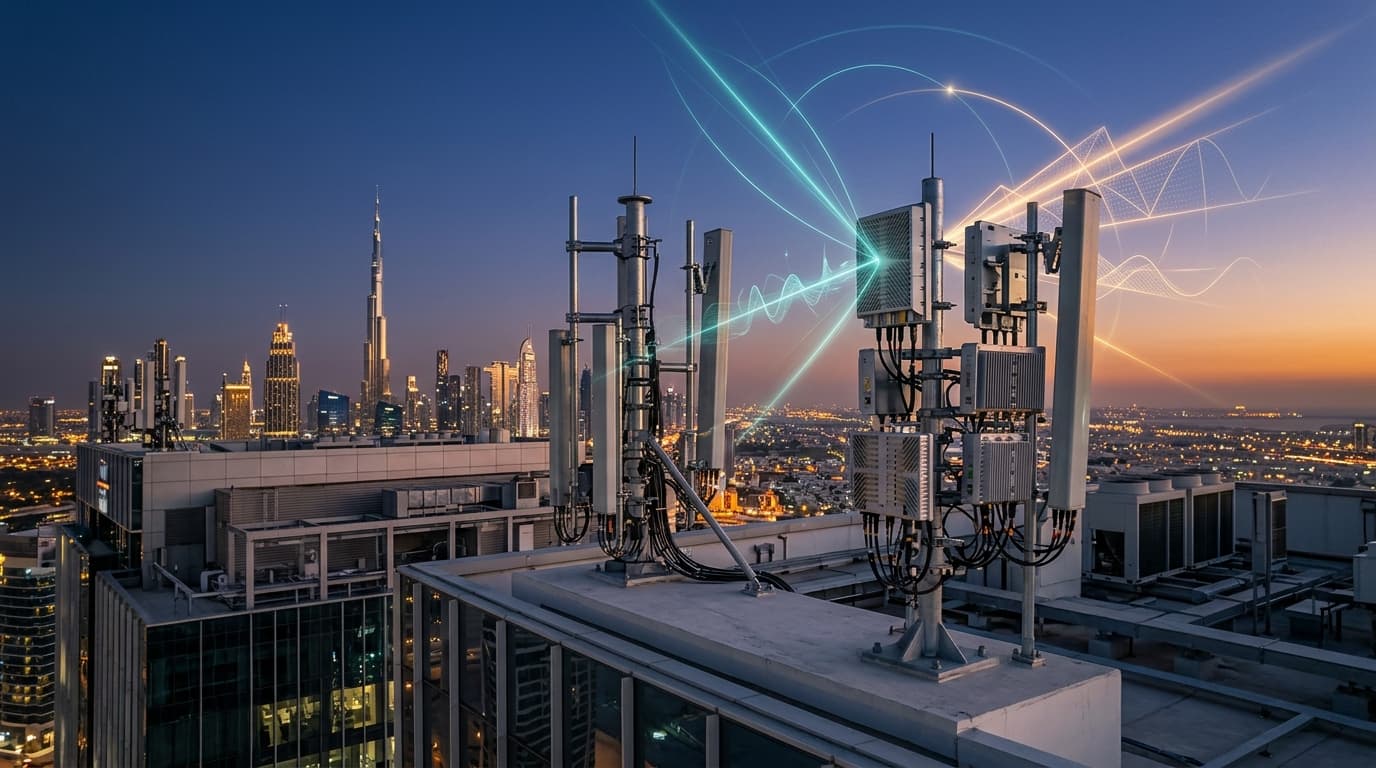
One genuinely novel capability in 6G is using radio reflections intentionally instead of treating them strictly as interference. Because high-frequency waveforms bounce predictably off vehicles, pedestrians, and precipitation, a single 6G tower can act simultaneously as a data pipe and an anonymous ambient radar sensor—alerting connected vehicles to cyclists hidden beyond an intersection or tracking micro-weather patterns without installing standalone cameras everywhere.
6G Wireless Technology FAQs
QShould I hold off buying a new smartphone or router waiting for 6G?▼
QWill 6G drain smartphone batteries faster than 5G?▼
QDo higher 6G frequencies pose new health risks?▼
Infrastructure Reality: Fiber Backhaul Remains the True Bottleneck
Moving wireless bitrates into hundreds of gigabits per second exposes an uncomfortable infrastructure truth: airwaves are only the final few hundred feet of your connection. Every ultra-dense 6G micro-cell requires multi-100G optical fiber backhaul underneath sidewalks and office ceilings, alongside upgraded distributed core switches capable of sub-millisecond edge routing. That civil-engineering reality—digging trenches, pulling fiber, and securing rooftop power leases—is why practical deployments expand neighborhood by neighborhood over years rather than flipping a switch nationwide overnight.
What Smart Consumers Should Upgrade Before 6G Arrives
If you want 6G-grade reliability indoors right now without waiting until 2030, invest in the wired backbone inside your own walls: run Cat 6 Ethernet to fixed workstations, upgrade congested ISP combo routers to Wi-Fi 6E or Wi-Fi 7 mesh nodes, and check whether your local carrier already enabled 5G Standalone (5G SA) Voice over NR on your current plan. Fixing indoor spectrum congestion delivers far bigger daily wins today than chasing next-decade wireless acronyms.