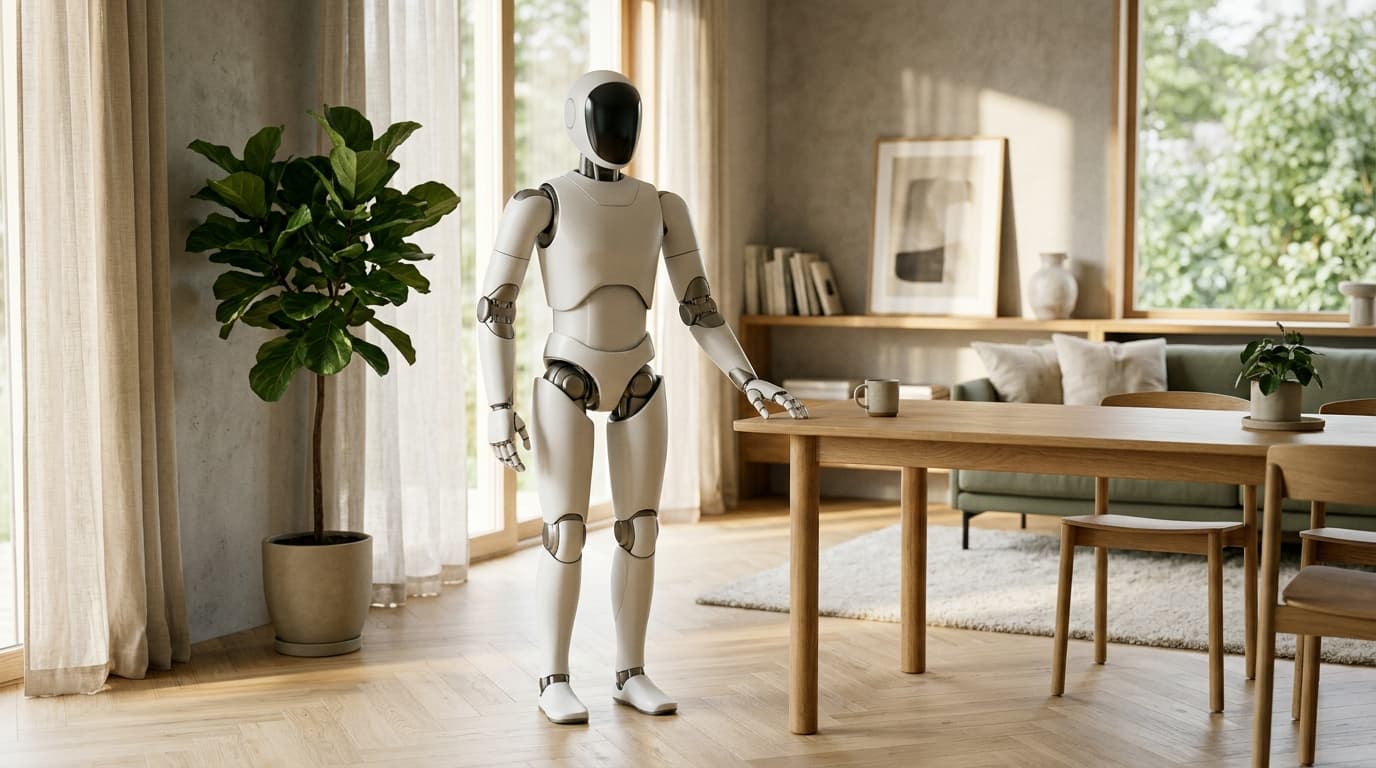
For nearly a century, popular science fiction has promised humanity a very specific technological vision: an intelligent mechanical butler walking on two legs, navigating domestic living rooms, washing dinner dishes, vacuuming staircases, and carrying groceries with effortless grace. Over the past twenty-four months, that fantasy appeared to suddenly materialize in reality. Dazzling promotional videos from Tesla (Optimus), Figure AI, Boston Dynamics (Atlas), and Sanctuary AI show bipedal metallic humanoids making espresso, sorting laundry into hampers, and walking with human-like gaits.
The investments pouring into humanoid robotics are staggering—billions of venture capital and corporate enterprise dollars backing the thesis that embodied artificial intelligence will become a larger consumer market than the smartphone and automobile industries combined. Yet, behind the carefully edited thirty-second demo reels and staged laboratory lighting lies a massive chasm between scripted teleoperation and autonomous domestic capability. To understand when—and if—a humanoid robot will ever clean your kitchen, we must examine the five formidable engineering hurdles.
Hurdle 1: The 'Moravec's Paradox' of Dexterous Hands
In the 1980s, roboticist Hans Moravec observed a profound truth: computers can easily beat grandmasters at chess or solve complex differential calculus, but giving a computer the perception and fine motor skills of a two-year-old child to pick up a strawberry without crushing it is nearly impossible. This principle remains the single greatest bottleneck in robotics.
Human hands are biological masterpieces of engineering, packing twenty-seven bones, thirty-four muscles, and thousands of mechanoreceptors providing real-time tactile feedback on friction, slip, elasticity, and temperature. Creating a robotic hand with twenty degrees of freedom that can delicately grasp an egg, firmly turn a stuck brass doorknob, and pinch a paperclip—all while being durable enough not to break when dropped—pushes the boundaries of materials science. Most viral videos of robots folding laundry are either sped up four times or operated remotely by a human wearing a VR motion-capture suit (teleoperation).
Hurdle 2: The Energy Density and Battery Conundrum
Maintaining dynamic balance on two inverted pendulums (human legs) is energy-intensive. A 160-pound humanoid robot contains forty to sixty high-torque electric actuators, hydraulic pumps, harmonic drive gearboxes, and multiple compute processors running real-time vision neural networks.
Even with modern 2.5kWh lithium battery packs squeezed into their torso cavities, most current humanoid prototypes can only walk and manipulate objects for roughly two to four hours before requiring a complete recharge. While an industrial automotive factory can rotate robots through swappable charging docks, an in-home robot that dies mid-cleaning after two hours offers dubious consumer utility.
Hurdle 3: Spatial Generalization in Cluttered Homes
Factory assembly lines are predictable, highly structured environments: every car chassis arrives at the exact same millimeter coordinate, under identical 500-lumen lighting, on a clean concrete floor. Domestic homes are chaotic anarchy. Dogs dart unexpectedly between legs, toddlers drop slippery toys on shag carpets, lighting changes from morning glare to midnight shadows, and furniture moves daily.
Vision-Language-Action (VLA) models are bridging this gap by translating spatial video feeds directly into motor actuator commands. But until a robot can handle edge cases with 99.999% reliability, allowing a 150-pound metal machine to carry boiling soup around toddlers presents massive liability risks.
The Economic Cost Curve: From $150,000 to $20,000
Today, building a single prototype humanoid robot costs between $100,000 and $250,000 due to specialized titanium machining, expensive strain-wave harmonic gears, and low-volume actuator manufacturing. Tesla and Figure AI argue that mass automotive-scale manufacturing can drive unit costs down to $20,000 to $30,000 by 2030.
Because of these economics, humanoid robots will deploy exclusively in industrial warehouses (moving heavy tote boxes and palletizing auto parts) for the next five years, where they can offset expensive human labor 24/7. Only after industrial deployments amortize manufacturing tooling will consumer domestic models become economically viable.
The Realistic 10-Year Timeline
- 2025–2028: Industrial Pilot Deployments: Humanoid robots work in Amazon distribution centers and automotive factories performing repetitive, structured heavy-lifting tasks.
- 2028–2031: Commercial Hospitality & Healthcare: Specialized eldercare assistance robots enter assisted living facilities to help transfer patients and deliver medical supplies.
- 2032 and Beyond: The Mainstream Domestic Era: Reliable, safe, lightweight domestic robots capable of autonomous laundry folding, kitchen cleanup, and general tidying arrive in upper-middle-class consumer homes.