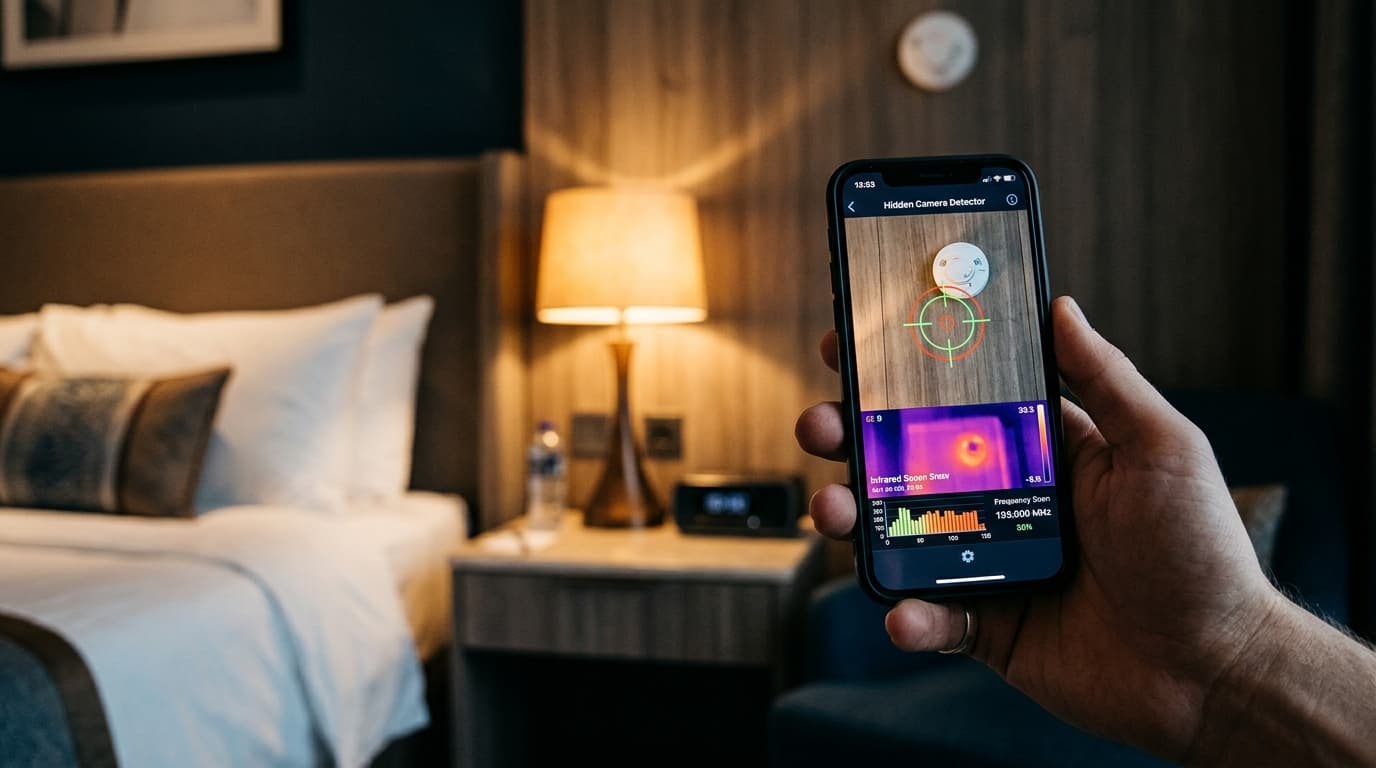
Arriving at a boutique hotel room or coastal vacation rental should signal relaxation, not paranoia. Yet headlines uncovering unethical hosts hiding miniature pinhole cameras inside alarm clocks, television brackets, and bathroom fixtures have made travel security a legitimate consumer priority. While specialized commercial radio-frequency sweepers exist, you already carry a powerful multi-sensor security tool right in your pocket: your smartphone.
You do not need to dismantle the drywall or spend hundreds of dollars on spy-hunter gadgets. By executing this systematic five-minute room inspection using your phone's camera, flashlight, and Wi-Fi interface, you can eliminate privacy doubts and sleep with complete peace of mind.
The High-Risk Zones: Where Pinhole Cameras Are Actually Concealed
Covert cameras require two physical constraints to function: a clear line of sight to private living areas (beds, changing stations, showers) and a continuous electrical power source. Battery-powered spy cameras only last a few hours, meaning ninety-five percent of real-world rogue cameras are hardwired into existing electrical appliances. Focus your immediate attention on:
- Bedside Digital Alarm Clocks: Specifically modern USB charging cubes and retro LED displays with glossy front acrylic faces.
- Smoke Detectors & AC Vents: Mounted directly above bed headboards or vanity mirrors with unusual tiny black dots.
- USB Wall Chargers & Multi-Plug Adapters: Bulky charging blocks plugged into low wall outlets that have no apparent functional purpose.
- Television Screws and Cable Boxes: Tiny pinhole openings oriented horizontally across from the bed.
- Decorative Picture Frames: Small holes punched into matte borders or framed artwork canvas.
Technique 1: The Optical Flashlight Glint Test
All optical lenses, regardless of how microscopic, are constructed from curved glass or optical-grade polymers coated with anti-reflective compounds. When light hits a lens at a perpendicular angle, it reflects a bright, pinpoint glint of blue or purple light directly back at the source—a physical phenomenon known as retroreflection.
Turn off all the lights in your hotel room and pull the blackout blinds until the space is pitch-black. Turn on your smartphone's LED flashlight, hold the phone right next to your eye level (to keep the reflection angle tight), and sweep the beam slowly across suspicious appliances from a distance of two to three feet. If you spot an intense, bright pinpoint reflection that stays fixed as you move your head slightly, inspect that exact aperture under bright room lights.
Technique 2: Catching Invisible Infrared (IR) Night-Vision Lenses
Cameras designed to record in darkness rely on infrared light-emitting diodes (LEDs) that operate on an 850nm or 940nm wavelength. The human eye cannot perceive infrared light, but modern silicon camera sensors can—especially front-facing selfie cameras and specialized macro lenses that lack heavy infrared cut filters.
To test your phone's sensitivity, take an ordinary television remote in a dim room, point the remote at your phone's front selfie camera, and press any button. If you see a pulsing purple or white glow on your phone screen, your sensor detects infrared light. Once verified, darken your rental room completely, open your phone camera app, and pan slowly across smoke detectors, electrical outlets, and clock faces. If a camera is broadcasting night-vision illumination, it will blaze like a small purple spotlight on your display.
Technique 3: Running a Local Wi-Fi Subnet Audit
Most modern consumer spy cameras do not record solely to internal microSD cards—they stream live surveillance footage to the host's remote smartphone over local Wi-Fi. Many hosts carelessly connect these devices to the same guest network password they share with visitors.
Connect your smartphone to the property's guest Wi-Fi and download a verified network auditing tool like Fing (available for both iOS and Android). Run a fresh network scan. The scanner will return a complete inventory of every connected IP address, MAC address, and device manufacturer on the subnet. Scrutinize the results for entries named 'IP Camera', 'Tuya', 'Hikvision', 'Dahua', 'RTSP', or generic hardware manufacturers like 'Espressif' (common microcontrollers used in DIY spy gadgets).
Technique 4: The Fingernail Test for Two-Way Mirrors
While rare, two-way mirrors in changing areas and bathrooms represent a serious privacy breach. On a legitimate first-surface residential mirror, the reflective silvering sits behind a protective sheet of glass. Place the tip of your fingernail directly against the glass surface. If you observe a visible gap of a few millimeters between your real fingernail and its reflection, it is a standard household mirror. However, if your fingernail touches its reflection tip-to-tip with zero gap, you are looking at a second-surface or two-way observation mirror.