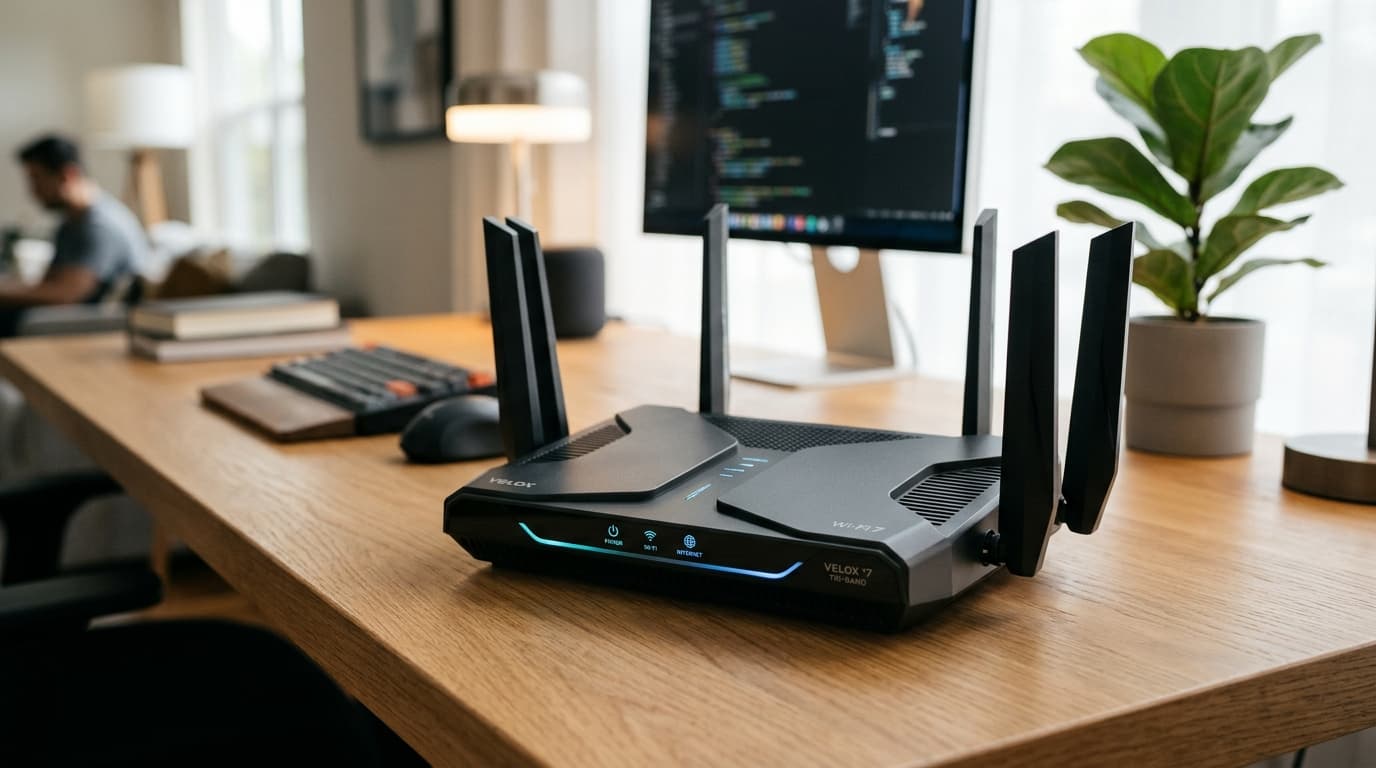
Stroll down any consumer electronics aisle right now, and you will spot router boxes boasting staggering claims of forty-plus gigabits per second alongside eye-watering price tags reaching well past four hundred dollars. If you find yourself pondering whether is Wi-Fi 7 worth it for home users in your specific living space, the genuine answer has very little to do with lab speed records and almost everything to do with the gadgets already sitting on your coffee table.
Our upfront verdict for the typical household enjoying high-definition streaming across a three-hundred or five-hundred megabit fiber subscription: you certainly do not need to rush out and replace your home network gear today. That said, if your family enjoys multi-gigabit broadband, frequently shuffles huge local video files across an in-house storage drive, or despises ping stutter during competitive online gaming sessions, the fresh 802.11be standard introduces genuine architectural fixes to frustrations that have annoyed home users for years.
Why the 802.11be Architecture Outclasses Previous Wireless Generations
Historically, nearly every bump in consumer networking simply turned up the throttle: making numbers bigger under pristine conditions without fixing real-world apartment clutter. Seventh-generation networking takes a remarkably different design philosophy. Rather than chasing sheer laboratory burst rates, engineers focused on deterministic latency, eliminating packet hiccups, and juggling dozens of noisy smart devices without breaking a sweat.
Multi-Link Operation: Erasing the Single-Frequency Bottleneck
Consider how your handset or ultrabook historically spoke with older home gateways: it essentially picked one solitary radio lane and stubbornly held onto it until the signal deteriorated entirely. Whenever an appliance kicked on or you walked behind a brick pillar, your connection stalled while the chip clumsily renegotiated a channel jump.
The latest standard fundamentally shatters that single-lane restriction through a technology labeled Multi-Link Operation, or MLO. Instead of forcing traffic onto an isolated airwave, your gateway can bind different radio spectrums together in real time, moving data packets over dual distinct frequencies simultaneously.
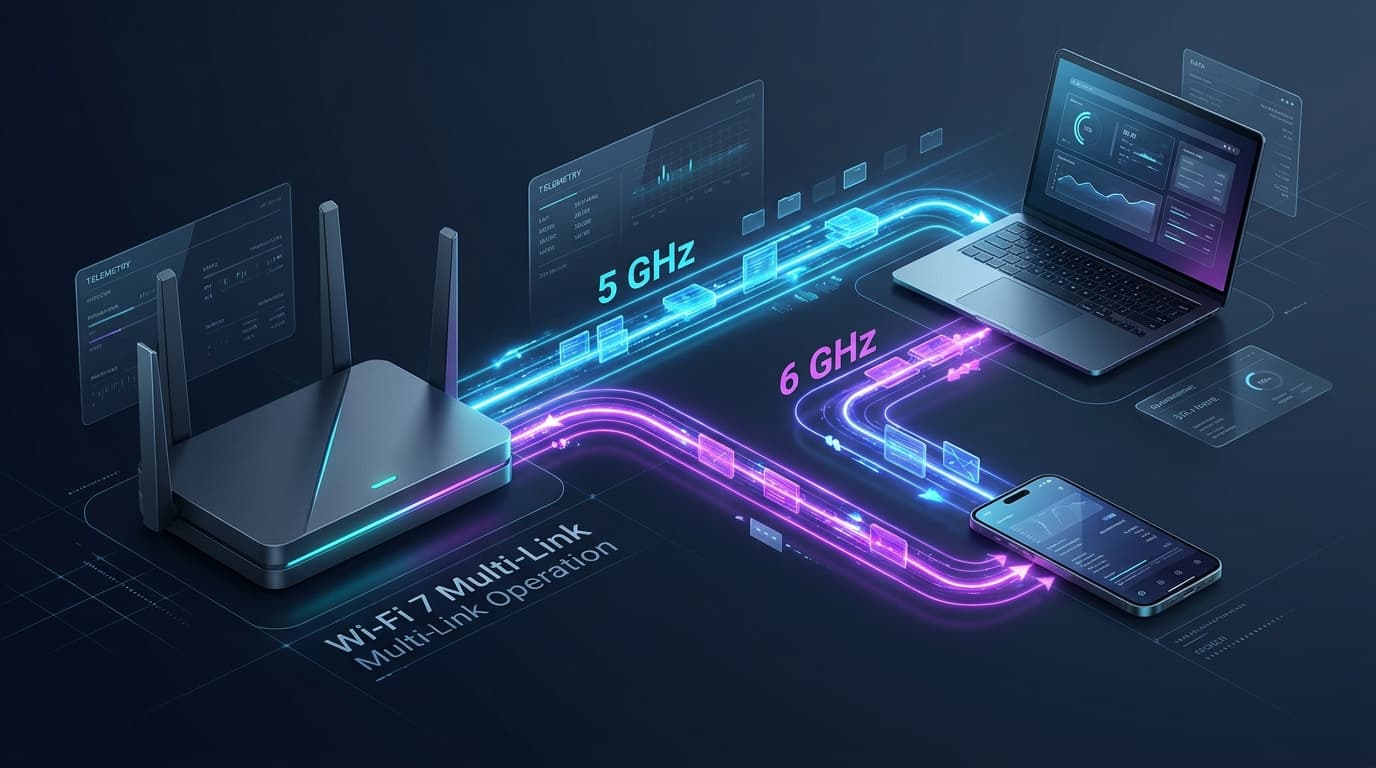
- Concurrent Spectrum Merging: Compatible devices combine airwaves to forge a single, high-capacity wireless transmission pipeline.
- Zero-Drop Packet Duplication: High-priority gaming commands and live video streams duplicate across channels; whichever arrives a fraction of a millisecond earlier gets used, practically eradicating packet drops.
- Interference Dodging: If an adjacent apartment crowds your lower radio band, your conversation continues uninterrupted across cleaner high frequencies without dropping your ongoing work call.
Massive 320 MHz Spectrum Width and Denser 4K Signal Modulation
Envision broadcast channels as lanes carved out along a busy metropolitan expressway. While sixth-generation hardware offered one-hundred-and-sixty megahertz paths, seventh-generation gear doubles that width to an expansive three-hundred-and-twenty megahertz swath across pristine high-frequency spectrum.
Accompanying those wider paths is an upgrade in signal density known as 4096-QAM. A straightforward mental analogy is a freight truck: rather than stacking roughly one thousand parcels per run as earlier hardware did, the transmitter tightly encodes more than four thousand data symbols within the exact same radio waveform. That translates directly to one-fifth more raw payload throughput on every single burst.
Generational Face-Off: Comparing Real-World Capabilities
| Technical Aspect | Wi-Fi 6 Generation | Wi-Fi 6E Extension | Wi-Fi 7 (802.11be) |
|---|---|---|---|
| Debut Era | Circa 2019 | Circa 2021 | Current 2024–2026 Wave |
| Radio Airwaves Utilized | Standard 2.4 & 5 GHz | Adds 6 GHz Spectrum | Unified 2.4, 5 & 6 GHz |
| Widest Single Channel | Up to 160 MHz | Up to 160 MHz | Massive 320 MHz Swath |
| Theoretical Upper Limit | Around 9.6 Gbps | Around 9.6 Gbps | Surpassing 40 Gbps |
| Signature Innovation | OFDMA Subcarrier Splitting | Clean Uncongested Airwaves | Unified MLO & Denser 4K-QAM |
| Hardware Retail Investment | Roughly $70 – $150 | Roughly $120 – $240 | Typically $260 – $600+ |
| Target Household Match | Everyday Web & Video | Crowded Apartment Complexes | Multi-Gigabit Enthusiasts |
The Real Bottlenecks: Details Retailers Avoid Mentioning
Before you whip out your wallet for shiny new networking gear, pause and evaluate two physical realities that marketing advertisements routinely gloss over.
First comes the receiver bottleneck. A state-of-the-art gateway cannot beam twenty-gigabit throughput to an older smartphone, an entertainment console, or a work laptop manufactured a few seasons ago. Radio conversations move strictly at the pace permitted by the slowest transceiver involved. Unless your receiving computer carries a native seventh-generation network card, your connection automatically drops down to standard legacy behavior.
Second is the ceiling imposed by your broadband subscription. If your monthly internet plan caps out at three hundred or six hundred megabits per second, plugging in an enterprise-tier wireless beast will not make remote websites or movie libraries load any quicker. Your household traffic can never surpass the physical fiber-optic strand entering your premises.
Before dropping four hundred dollars on an all-new mesh network, check if your current personal computer accepts a simple card swap. A modern Intel BE200 internal M.2 module costs under thirty-five dollars online and immediately equips a compatible laptop with 320 MHz reception without touching the rest of your home setup.
— Md Saifur Rahman, Lead Editor
Hands-On Observations: Where We Actually Noticed the Difference
In our long-term testing inside a living space crowded with more than forty active Internet-of-Things accessories, smart displays, and security cameras, we ran seventh-generation equipment alongside our dependable sixth-generation mesh setup. When casually browsing social media, checking emails, or streaming high-definition television, human perception simply cannot spot any difference between five hundred megabits and multiple gigabits.
The moment our jaw dropped, however, was during internal local storage backups. Moving massive directories of uncompressed high-resolution video between our editing machine and a localized storage bank over a multi-gigabit switch produced continuous wireless transfers cruising beyond two gigabytes each second. That effectively mimics an expensive, wired Thunderbolt tether without stringing messy cables through your doorways. Equally impressive was online multiplayer gaming: even while another family member downloaded an enormous desktop operating system patch in the background, our match latency remained rock-solid without a single stutter.
Who Should Jump On It Now Versus Who Ought to Wait?
Upgrading Makes Genuine Sense If:
- Your household subscribes to two-gigabit, five-gigabit, or ten-gigabit fiber and you yearn to untether those speeds from physical wall ports.
- You routinely migrate gigantic digital files between networked workstations and local storage clusters.
- You immerse yourself in wireless virtual reality streaming where instant response times make the difference between fun and motion sickness.
- Your dwelling is plagued by severe signal dropouts caused by dozens of competing neighbor networks.
You Are Far Smarter Waiting If:
- Your existing broadband service provides between one hundred and five hundred megabits.
- The portable devices in your home were purchased prior to 2024 and lack the matching internal reception antennas.
- Your current wireless setup comfortably covers every room without dropping Zoom calls.
- You appreciate getting optimal value by letting early-adopter price premiums cool down over the coming seasons.
The Concluding Takeaway for Everyday Consumers
Seventh-generation wireless isn't just an empty numerical refresh; features like Multi-Link Operation stand as the most meaningful practical evolution in domestic radio technology since the inception of dual-band networks. It genuinely tames jitter, resolves channel congestion, and builds bulletproof stability.
Even so, for the vast majority of ordinary consumers, purchasing right now remains an expensive luxury designed for early adopters rather than an urgent necessity. If your current internet setup behaves reliably, feel completely comfortable holding off until client devices become standard and hardware prices settle into sensible territory. But if you possess the compatible equipment, multi-gigabit connectivity, and enthusiasm, seventh-generation wireless delivers the closest thing to tethered Ethernet reliability ever unleashed across the airwaves.