Every tech enthusiast knows the frustration: our smartphone processors advance by leaps and bounds each year, camera sensors capture cinematic 8K footage, and displays refresh at silky-smooth 120Hz rates. Yet, the energy storage technology powering these pocket supercomputers has remained fundamentally identical since Sony commercialized the liquid lithium-ion battery in 1991. We are squeezing the absolute theoretical limits of conventional chemistry, forcing engineers to adopt aggressive software throttling or bulky chassis designs just to guarantee a full day of battery life.
The long-heralded holy grail of energy storage is the solid-state battery (SSB). Promising two to three times the energy density of modern cells, charging speeds under fifteen minutes, and total immunity to thermal runaway fires, solid-state technology could revolutionize everything from electric vehicles to featherweight smartphones. But after ten years of breathless laboratory press releases, why aren't they in our pockets yet?
Chemistry Explained: Liquid vs Solid Electrolytes
To understand the monumental engineering hurdle of solid-state technology, you must examine how a conventional battery functions. A standard lithium-ion cell consists of four primary components: a positive cathode (typically lithium cobalt oxide or nickel-manganese-cobalt), a negative anode (graphite), a porous polymer separator, and a volatile liquid or gel electrolyte that allows lithium ions to shuttle back and forth during charge and discharge cycles.
That liquid electrolyte is both the battery's greatest strength and its most dangerous vulnerability. It is highly flammable. If an internal short circuit occurs due to physical puncture, manufacturing defect, or overcharging, the liquid heats up exponentially, triggering catastrophic thermal runaway—the notorious battery fires that have grounded aircraft and recalled millions of consumer devices.
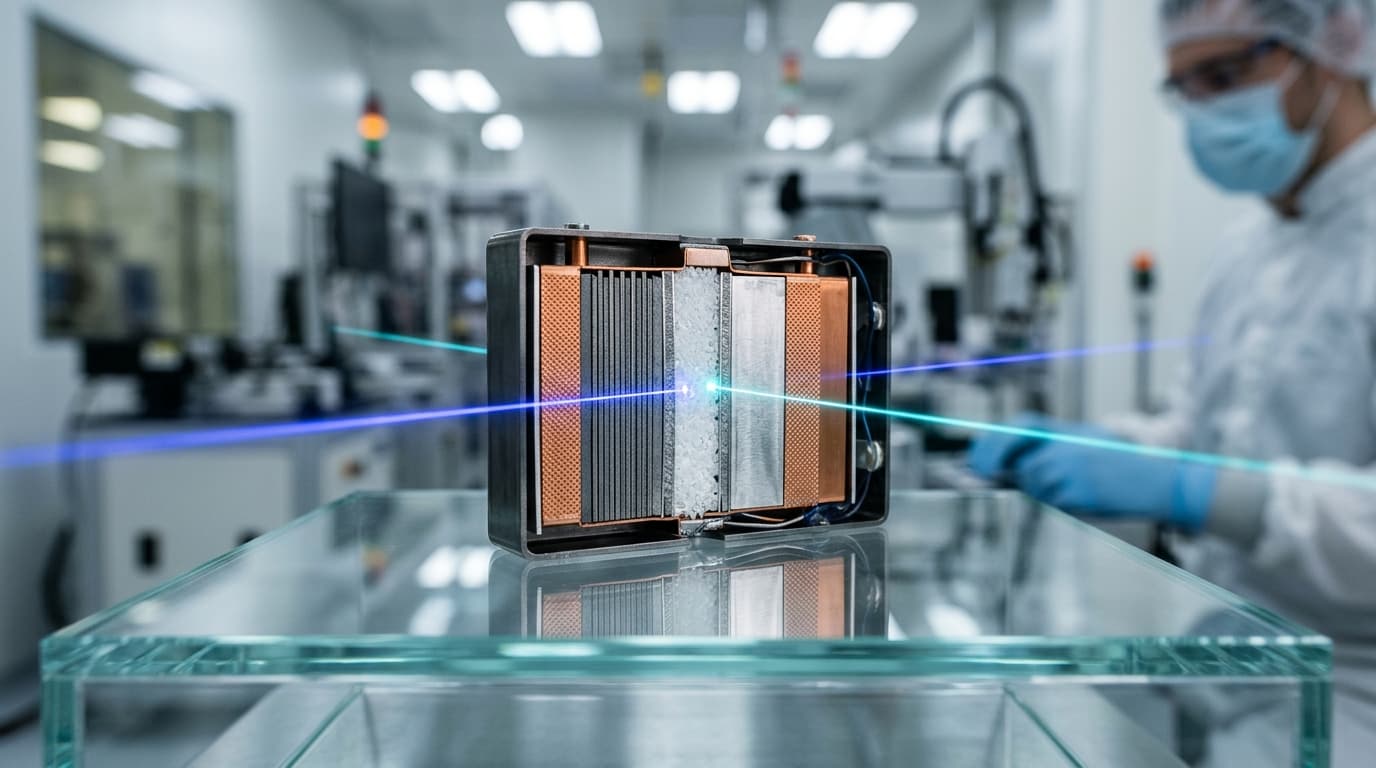
A solid-state battery replaces that volatile liquid with a solid ceramic, glass, or sulfide-based electrolyte. This architectural shift enables three transformative advantages:
- Pure Lithium-Metal Anodes: Because solid electrolytes prevent microscopic needle-like lithium crystals (dendrites) from punching through, engineers can replace heavy graphite anodes with razor-thin pure lithium foil, dramatically boosting volumetric energy density.
- Extreme Thermal Safety: Solid ceramic electrolytes do not catch fire or release combustible gases even when punctured by a steel nail or heated to 200°C.
- Blistering Fast Charging: Without the risk of boiling liquid solvents, solid-state cells can absorb massive electrical current without dangerous degradation, enabling 0% to 80% charge times in 10 to 12 minutes.
Technical Comparison: Traditional Lithium-Ion vs Solid-State Chemistry
| Specification | Conventional Li-ion | Solid-State Battery (SSB) | Practical Consumer Impact |
|---|---|---|---|
| Energy Density | 250 – 300 Wh/kg | 450 – 550 Wh/kg | Double phone battery life in same physical thickness |
| Flammability | High (Liquid solvent) | Near Zero (Solid ceramic/sulfide) | Zero risk of phone explosions or battery fires |
| Fast Charge Time | 30 – 60 minutes | 10 – 15 minutes | Full charge during a quick morning shower |
| Cycle Longevity | 500 – 800 cycles | 1,500 – 3,000 cycles | Battery maintains 90% health after 6 years of daily use |
| Production Cost | ~$100 / kWh | ~$250 – $350 / kWh (Current) | High initial premium until manufacturing scales |
The Remaining Engineering Hurdles
If the physics are so undeniably superior, what is delaying mass commercialization? The primary obstacle is the solid-solid interface problem. Unlike liquid electrolytes, which effortlessly wet every microscopic crevice of the electrode surfaces, solid materials naturally expand and contract as lithium ions enter and leave during charging. Over hundreds of cycles, microscopic voids form at the interface between the solid electrolyte and the electrodes, causing internal resistance to skyrocket and battery capacity to plummet.
Solving the interfacial resistance problem requires either applying immense mechanical pressure (using internal spring clamps inside the battery enclosure) or developing semi-solid hybrid electrolytes that combine gel interfaces with solid cores.
The Realistic Arrival Roadmap: 2026 to 2030
Based on verified pilot line deployments from leading battery consortia (CATL, Samsung SDI, Toyota, and QuantumScape), the transition will unfold across three distinct phases:
- Phase 1: Semi-Solid Hybrids in Premium Consumer Electronics (2025–2027): Manufacturers are already shipping 'semi-solid' batteries that incorporate 5% to 10% gel electrolytes to stabilize ceramic separators. Expect ultra-thin flagship foldables and premium smartwatches to adopt these cells first.
- Phase 2: Luxury Electric Vehicles (2027–2028): Toyota, BMW, and Volkswagen have confirmed pilot vehicle testing for all-solid-state packs with 1,000 km (620 mile) range targets. Because automotive batteries command higher price tags, luxury EVs will absorb early manufacturing costs before consumer tech.
- Phase 3: Mainstream Smartphones and Laptops (2028–2030): As gigafactories achieve high roll-to-roll manufacturing yields, solid-state cells will reach price parity with conventional lithium-ion, making two-day smartphone battery life the standard expectation.